December 21, 2012

12 Salisbury Cathedral


In September we took a quick 3-day trip down to Bath, Stonehenge, Salisbury, and Avebury. To say it was a whirlwind would be an understatement and our lack of time did a great disservice to both of these amazing cities. We will get back to each of these historic places one day. In the meantime, I've got my pictures from our little jaunt.
Salisbury Cathedral sits in a lovely green space, which was filled with people enjoying the beautiful day. A bit envious of their leisure, we hurried into the cathedral to crane our necks in awe once again.


The main part of the cathedral was completed in a very quick 38 years during the mid-13th century, and has the tallest spire in the United Kingdom.


A large reflective four-pointed... shape... is in the center of the nave.  It offers a new perspective as well as a break for the neck-craning.


I just love the ceilings. I want elaborate ceilings everywhere.


I also love arches, especially painted ones.


The Quire stalls are the largest in Britain as well as being the first completed. I love the intricate carvings of most quire stalls, but the animals on this one were especially fascinating!


Salisbury Cathedral's Chapter House is also home to the best preserved copy of the Magna Carta, and one of only four of the original 1215 version (no photographs allowed, though). Another copy resides at Lincoln Castle, which we unfortunately weren't able to see during our visit to Lincoln. We'll be back, though!


The cloister, as usual, was Paul's favorite part. I wouldn't turn it down, either!


When you go to Stonehenge (more on that in a future post), be sure to take some time around Salisbury. Not only is it a charming city, but its beautiful cathedral inspired an incredible novel, Ken Follett's Pillars of the Earth, which I strongly recommend reading before you visit any of Europe's incredible cathedrals and abbeys.  If you're not a reader, well, then, just be astonished and amazed at the immense beauty in these masterpieces of architecture.


Can you tell I miss Great Britain?!?

July 19, 2012

4 St. Conan's Kirk, Loch Awe

 A bit of our drive up to Oban was spent alongside Loch Awe- a beautiful loch surrounded by lush growth and charming villages. We'd seen Loch Awe before, but it still inspired a response akin to its name.
What I wasn't expecting was to see a kirk (church) nestled alongside the loch- just off the road, but nearly covered by a patch of trees. I managed to see the sign "St. Conan's Kirk", and jotted it down on my post-it as a stop on our way back.
Cue two days later... and St. Conan's Kirk was our first stop after leaving Oban.

There is a small area next to the road that would fit only 2-3 cars. From there we walked up to the kirk, and I was already getting excited.

 For a bit of the kirk's history: in the 1870s, a man named Walter Douglas Campbell bought the Island of Innischonan and built a mansion on it for himself, his sister, and his mother. According to the lore, the elder Mrs. Campbell found the drive to the closest parish church in Dalmally to be too far- so her loving son decided to build her a church closer. 

 Beginning in 1881, Walter Campbell designed St. Conan's himself, with his architecture inspired by nearly all ecclesiastic periods in Scotland's past.  Campbell used local workers and mostly local materials- the stones themselves are boulders rolled to the site, rather than quarried blocks.
The work was delayed by the two World Wars, and then by Campbell's death in 1914. Helen, his sister, carried on his work until her death thirteen years later. A group of Trustees saw to the culmination of the project in 1930. 

 The view that took my breath away.
 The communion table sits in the center of the apse.

 The nave.

The nave, looking towards the South aisle.

 An odd rose window!


 An effigy of Robert the Bruce, complete with a bone fragment from Dumferline Abbey. The window here, overlooking the loch, was originally in St. Mary's Church, South Leith.  Built in 1483, St. Mary's was rebuilt four hundred years later and this west window was removed to Edinburgh as a garden ornament. Campbell incorporated it, along with a handful of other artifacts, in his building. 

 I couldn't get enough of this magnificent ambulatory!

 A painting of the chancel hangs there- and is just as beautiful!

 Chancel and nave, from near the communion table.

 Campbell's Dolphin chairs, believed to have come from abroad.

 Two wrought-iron gates herald the Lymphads of Lorne, part of Scotland's historic heraldry.

 The cloister garth, a peaceful and lovely place. Paul wants one.

 An aisle of the cloister.

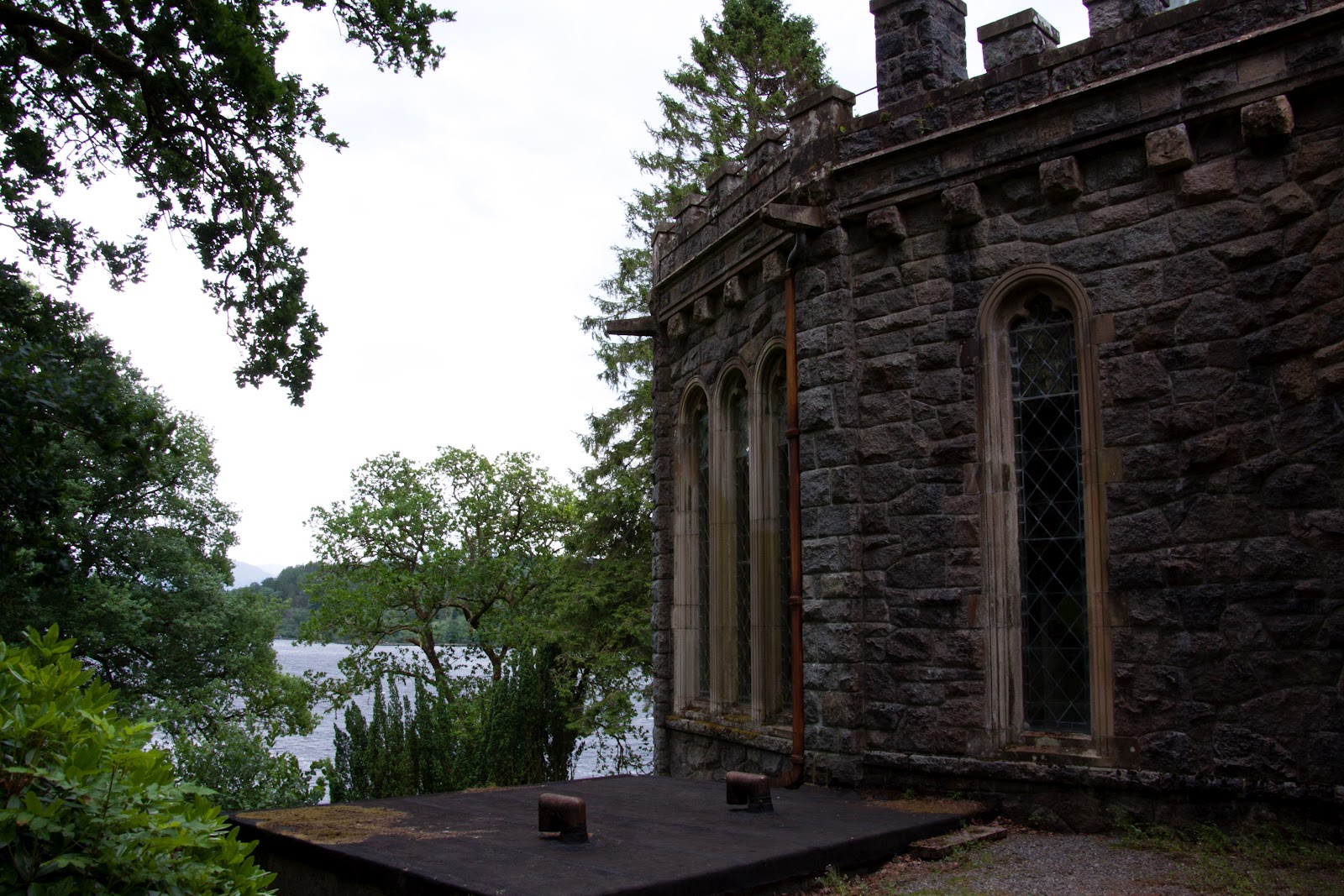
 The exterior of the loch-side of the kirk.  See the owls?

 A very strange rabbit, too...

 The loch side of the kirk. 

One last view...
Wow.

July 17, 2012

2 Iona

 The Isle of Iona sits less than a mile from Fionnphort, Mull. In fact, Fionnphort seems to exist solely to house a handful of B&Bs, some free-range sheep, and the every-half-hour ferry across to Iona.
We didn't have much time on Iona, due to the circumstances of the day. However, we did the best with the time we had. 

 Iona Nunnery was established in 1203, but fell into disrepair soon after the reformation. The walls are made from pink granite.


 We passed some scarecrows... yep.

 Iona Abbey was first established by St. Columba after he set off from Ireland to bring Christianity to the Picts. The monastery was originally in wood, but was first erected in stone around 1200. 

 Heavy restoration was done in the first half of the 20th century, but the work held true to the original structure.


 I love the unusually shaped windows!

 Not a bad pulpit chair!

 This little room was off to the side of the main door.  The entryway was very short, as were many of the side-room entries at the abbey.


 The remains of a fire surround. 

 A home on Iona. Mine...?

 As we boarded our boat to return to Mull, a flock of seagulls came by to see us off!

Come back tomorrow for some pictures from Mull!
Previous Post Home